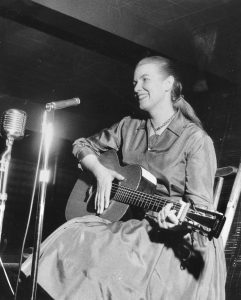
In her own words, Ellen tells the story of her friendship with Pete Seeger and the story behind her cover of his song “Old Devil Time.” The song is available now on all major streaming and digital platforms and can be purchased on her Bandcamp page. To view her exclusive photographs of Pete Seeger, visit https://ellenstekert.darkroom.com/.
I learned this song from a woman named Elli Winters when I was first teaching at Wayne State University in Detroit. I later was told that Pete Seeger had written it, and that he had composed it at the last minute when he was asked to write a song for the film Tell Me You Still Love Me, Junie Moon. It has always been one of my favorites; it shows Pete’s remarkable musicality and his inclusive sensitivity.

One day when I was working on an arrangement of the song "Come All Ye Fair and Tender Maidens", also known as "The Little Sparrow", I was struck by how similar the melody was to "Old Devil Time." It seemed to me that Pete might have had the traditional song in mind when he composed "Old Devil Time." I never did ask him about it, and I suppose it really does not matter, but by not asking, I missed an opportunity to see a bit into the mind of one of the most influential musicians of our time.

I do miss Pete. He seemed indestructible. He was always encouraging to other performers as well as folksong enthusiasts. He was positive almost to a fault. I remember how surprised I was at his handshake — you expected it to be firm and steady, after all he was a banjo player, but it was surprisingly gentle, almost limp.

Pete had few obvious aggressive traits. He was one of the most generous and gentle, yet compelling ambassadors still left of the few remaining souls who bridged the gap between World War II the first part of the Folksong Revival and the Second (the 1930s though the 1980s). Even though he was blacklisted by the U.S. government during the McCarthy era, it seemed to not decrease his influence on American popular culture.

Pete and I were long-time acquaintances, good enough to call each other friends. We had met at New York City "hoots"—informal musical jam sessions—in the late 1940s, and he followed my education and training in folklore, even mentioning me in his Sing Out column when I drove across country alone in my basic VW in 1956, singing my way and collecting/recording traditional material. When I had become a teaching professor, he often let me know when he would be in my vicinity and dropped in for a visit. One photo, which has been released to my online gallery (ellenstekert.darkroom.com), was taken during such a visit to Minneapolis around 1983.

Those of us who were around folksinging circles during the Revival have our Pete Seeger stories, and some of those stories also include others who were moving forces in the movement. My favorite story was told to me by Jean Ritchie, and I find it an endearing one since it is about a major event in the history of the folksong movement in the U.S. Here is how Jean told it to me:

Jean and Pete were backstage monitoring the performers onto and off the stage at the Newport Festival in 1965. All seemed to be going well when Bob Dylan took the stage in front of the thousands of excited fans present. According to Jean, Bob sang a number of acoustic songs and then, in a surprise move, switched to a high-volume set of electrified pieces with his band. The crowd went wild (both pro and con). Pete had long advised Bob not to go electric, yet here he was, defying Pete’s advice, not having forewarned anyone on the Newport Board of Directors (including Jean). That sent Pete (formerly a gentle supporter of Dylan), scurrying around, looking at the ground. Jean (who was a studied avoider of controversy) after watching him for several minutes, asked him what he was doing, to which he replied, "I’m looking for a stone to throw through that blasted machine!"

That was Jean’s story, but the idea of Pete becoming so angry as to want to throw a rock through Dylan’s amplifier, and Jean, who had avoided controversy at all costs in her career as a gentle Southern Mountain lady, both comforting one of the pivotal revolts of the Folksong Revival, is enough to be a memorable event.

Both Jean and Pete were being part of an event that was an historic and violent disruption and rebellion within the industry and social movement that had given each their celebrity status. Jean, who put her grandfather’s name as a pseudonym on her “protest songs” about the Harlan coal mining, and Pete, who had faced the U.S. congress’ House Un-American Activities Committee, had finally met their Waterloo in a bloodless coup that was inevitable.

The previous story about a story is an analysis of a story told by another person who is implicated but not the focus of the initial story but who actually factors in it and into yet another story... And that is the plight of the professional intellectual—and at times it is enlightening, but only at times. Nonetheless, it is through stories that we learn. Beware of story-tellers and remember to be "critical" in the best way; that is, think on what you hear.