Month: July 2026

Lost 1960 Jean Ritchie concert recording and rare photographs unearthed from the archives of folklorist Ellen Stekert

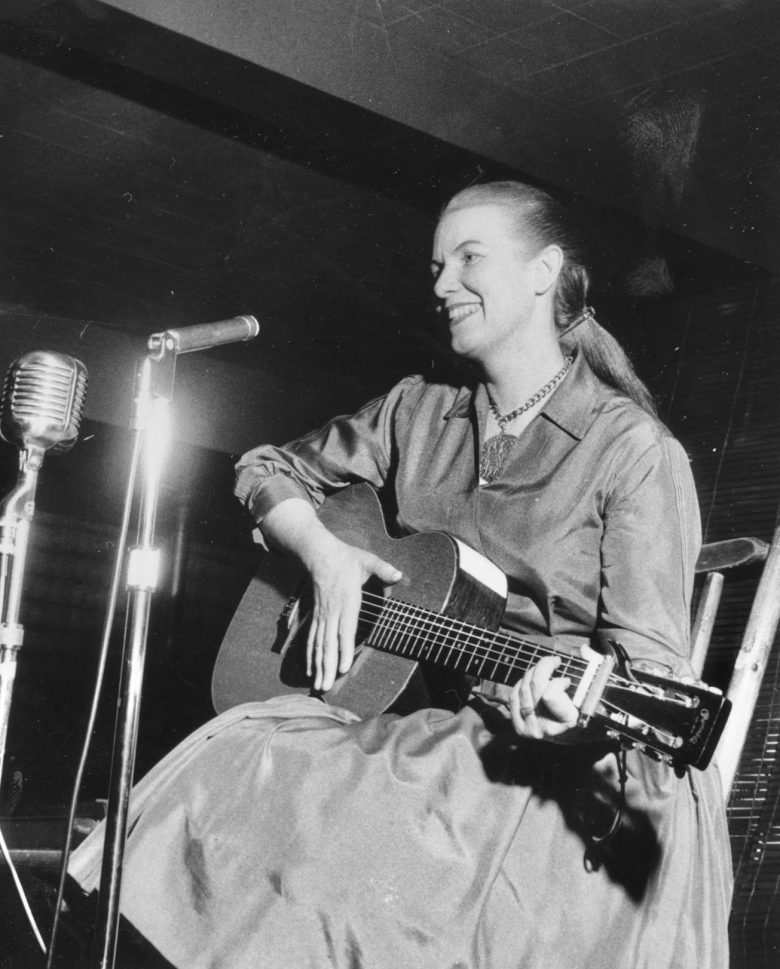
Jean Ritchie at Indiana University, 1960

A major historical discovery offers a rare, high-fidelity window into the “Mother of Folk” in her prime, now available to the public alongside newly released archival photographs.

A remarkable piece of American music history has emerged from the archives of legendary folksinger and folklorist Ellen Stekert. Today marks the official multimedia release of a previously lost 1960 Jean Ritchie concert recording, complete with a companion gallery of rare, intimate photographs taken during Ritchie’s visit to Indiana University.

The complete, newly remastered concert audio can be heard for free on the Swingin’ Pig YouTube Channel, which is embedded below. Concurrently, Stekert’s stunning archival photographs of Ritchie have been made available for viewing and purchase at her official Darkroom store.

In the late 1950s and early 1960s, Jean Ritchie was a towering figure in the American folk music revival, widely celebrated for her mastery of Southern Mountain a cappella ballads and the mountain dulcimer. In 1960, Stekert arranged for Ritchie to perform a solo concert at Indiana University in Bloomington—then the premier center for graduate folklore studies in the United States. The performance was captured on tape and later broadcast on Stekert’s radio program, The World of Folk Music, on WFIU.

For over six decades, the original reel-to-reel tapes remained preserved in Stekert’s personal collection until her producer, Ross Wylde, began the process of releasing her vast archive to audiences.

“This is a major archival discovery,” says Wylde, who mixed and remastered the 1960 recording. “Very few complete, high-fidelity live recordings of Jean Ritchie exist from this pivotal era. There are several songs on this tape that have no known comparable versions elsewhere. Some of these renditions may very well be the last surviving examples of the ‘Mother of Folk’ in her prime.”

The newly released live set is split into two distinct halves: the first featuring the traditional Kentucky heritage songs of Ritchie’s upbringing, and the second highlighting ballads she personally collected during her travels through the British Isles. The recording captures not only her precise musicality but also the wit, charm, and storytelling that captivated early revival audiences.

Ellen Stekert, now 91, reflects on her late friend and contemporary: “Jean Ritchie wasn’t just authentic; she was special, a singular artist who bridged two worlds and left them both infinitely richer. She was a brilliant ambassador who combined the traditional world she grew up in with an ever-changing commercial market.”

Ellen on her friend and “imaginary rival,” Jean Ritchie

On the occasion of the release of a newly rediscovered 1960 concert by Jean Ritchie in Ellen Stekert’s archives, Ellen writes a reminiscence of her decades-long friendship with the folk-music icon. (Ellen also took the above photo of Ritchie in 1960. It is available on her photography store at Darkroom.com, along with many other of Ellen’s historic images.)

I had known of Jean Ritchie before I ever met her. In 1952 or '53, I was about to cut a record for Stinson Records. Around the same time, Jac Holzman had recently founded the now-famous Elektra Records as a small, independent folk label, and I was anxious to record for them—but Jac had found Jean Ritchie and said, “She’s the real thing.” So, Elektra cut one of their first folk records of Jean Ritchie.

A year or so later, I learned that Jean had received a Fulbright scholarship to go to England to find the "source" of her family’s traditional songs. I had applied for a Fulbright to England as well, and had not gotten it–it was the most coveted of the Fulbrights.

So, in a way, Jean Ritchie started off in my imagination as my rival!

On February 20, 1960, Jean Ritchie gave a concert at Indiana University in Bloomington, at that time the home of the most respected graduate program in folklore in the United States. It was a stellar concert. The first half featured traditional songs from Jean’s Kentucky heritage, and the second half featured songs collected during her Fulbright-sponsored travels to the British Isles.

As was her usual performance, it was a delightful evening. Jean’s wit and unaffected charm, combined with her outstanding and tasteful musicality and insight into her “roots,” gave the audience a rare view of the workings of tradition with an overlay of personal creativity.

I had arranged for Jean to come to Indiana University. I had known of her since the early-1950s, when she began doing concerts in New York City and the surrounding suburbs. I had always admired her and felt she was one of the great “translators” of a branch of America’s folk tradition, a connection for the New York City urbanites and other audiences to their assumed past: the Appalachian Mountains, one of the first great obstacles settlers from Europe had to overcome to form the United States, and one of the main focuses of this second part of the Folksong Revival that was sweeping the country.

In 1959, I was able to get to know her personally. We had both been recruited for a CBS TV program called Camera Three. The episode was called “Ballads Are News,” and each of us (Jean, the New Lost City Ramblers, Oscar Brand, and others) sang about historical natural disasters in the U.S. It was a successful program with good people, and we had an easy and enjoyable time working together. Each of us was given a song or two to sing. Jean and I sang a duet about the Santa Barbara earthquake. You can hear the program in its entirety on my Bandcamp page. While working together, I discovered that Jean lived very close to me and my family on Long Island. She and her photographer husband, George Pickow, had a house on top of a rise in Port Washington, just a hop and a jump away from my home in Great Neck, and fairly isolated from the buzz of Long Island traffic.

Several months later, I invited her to Indiana University. I invited and arranged for her appearance not only because of her wonderful talents, but also because the head of our Folklore program at Indiana University was decidedly antagonistic to the folksong revival. He treated those of his students (such as me and Joe Hickerson) who were even glancingly associated with it, as though we were inferior students. I wanted him to see a dignified and informative program of traditional folk music intelligently and beautifully performed. Unfortunately, he didn't even attend the concert.

Jean was anxious to come to Indiana University so she could meet some of the students and scholars who were studying folklore. So, after the concert, we had a blast of a party at the home of a fellow student. A few years before, Jean had been awarded a Fulbright scholarship to the British Isles to find the “sources” of her traditional family songs. She devoted the second half of her concert to those songs, and sang some that she had collected for us. It was clear why she had graduated Phi Beta Kappa from the University of Kentucky.

Jean’s husband had not accompanied her to IU, so I spent a good deal of time with her during the days she stayed in Bloomington. By the time she left, we felt we could call each other friends. I drove her to the airport followed by a gaggle of fans who stayed to see her off.

Over the years, she often asked me to come over and visit her in Long Island — her letters to me are full of invitations, but as a graduate student, I was too busy, and I now regret that.

In 1974, I wrote to Jean asking her to perform a concert at the University of Minnesota, where I had just been hired. I tried, but the various venues in the Twin Cities were all full by the date that I wrote her. However, she and George still came to visit. I gave them a tour of the city, and to my delight, she performed in my class. It was a treat for the students. It was the last time I saw her, although we kept in touch. I had become lost in the webs of academia and she was still in entertainment.

Some have called Jean Ritchie “the mother of the folksong revival.” Jean was even more than that. She was one of the best ambassadors of an American traditional art form, the Southern Mountain a cappella ballads and songs. Even more remarkable, she was an ambassador who created a new art form by combining the aesthetic of the traditional world in which she grew up, with that of an ever-changing commercial market. She not only presented a song in a vocal style as close to that which an urban audience at the time would accept, but she also produced a performance that was essentially a refined mix of authentic Southern Mountain music combined with unorthodox harmonies taken from the urban classical art world and used by her “traditional” dulcimer accompaniment. The single note harmony lines of her dulcimer were as good as, if not better, to the ears of the urban audience as those of Alfred’s Deller’s counter-tenor or Jean-Pierre Rampel’s flute.

Jac Holzman had it right all those years ago when he called her "the real thing"—though he only knew the half of it. Jean Ritchie wasn't just authentic; she was special, a singular artist who bridged two worlds and left them both infinitely richer.